
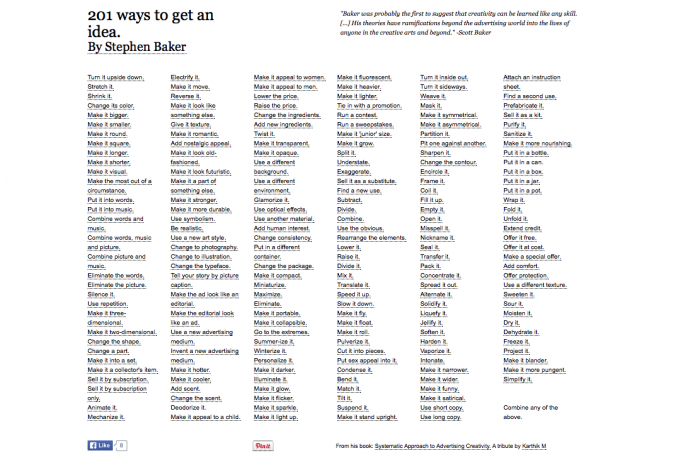
In the digital age, its more and more difficult to find something interesting happening in advertising. So we are thrilled to see anything interesting. And in comes “201 Ways To Get An Idea” by Karthik M.
“201 ways to get an idea” is an effective tool to generate ideas and concepts for advertising and other creative projects. Written by Stephen Baker — an art director during the creative revolution in the 1960s — as a part of his book Systematic Approach to Advertising creativity, the exhaustive list is a highly useful one and yet few people are aware of it. My small project is a tribute to this creative genius who deserves to be known more than he is today. : Karthik M
Karthik works as a Creative Director at Catalyst India, Bombay. Personal projects are a lot of fun and learning for him. He also tries his hand at Twitter fiction (@mysmallstories). “My parents still don’t know clearly what I do for a living, but they are happy that I have a steady job”, he says.
What is it?
It is an effective tool to generate ideas and explore various directions for the same. Written by Stephen Baker — an art director from the Creative Revolution during the 1960s and 70s as a part of his book called Systematic Approach to Advertising Creativity.
How did you think of it?
Quite a few years back, I was fortunate to come across it in a book called Craft of Copywriting given to me by my friend Asif. This list of a part of a certain chapter. The list just stuck to my mind all these years. And I found out that this great tool was never talked about offline or online. So I thought of making it into a web page and add my own spin to it.
What does it do?
Well, it helps you explore various directions when it comes to thinking about ideas and concepts. A little similar to mind-mapping, more than a concrete solution, it helps you to open your mind and explore various directions which you may have never thought possible. The biggest advantage I found about it is you don’t need to sit with a group and “brainstorm” for ideas. Sit with this list; think; scribble; doodle and ideas will come.
How do you think it will help?
The list is so simple that anyone and everyone can understand and play with it. It can be used by people in a group, or an individual. Two people may have different ways of exploring the idea using the same item in a list. The possibilities are endless. I think it will help a lot during brainstorming sessions.
How did you get the funds for it?
It is just a webpage. So no major funds needed.
It is one my initial web experiments, which I thought
I should share with people. That’s all.
Amazing ideas!